
GABRIELLA CRESPI
Born in 1922, Italian artist and designer Gabriella Crespi would have turned 100 the year GUBI produced the Bohemian 72 Collection for the first time. Throughout her extraordinary career in the design world, she moved effortlessly among both European royalty and the Hollywood jet set. Her indisputable glamour and sophisticated sense of style made her a muse to the fashion designer Valentino, and brought the likes of Audrey Hepburn, Gianni Versace, and Hubert de Givenchy into her social circle.
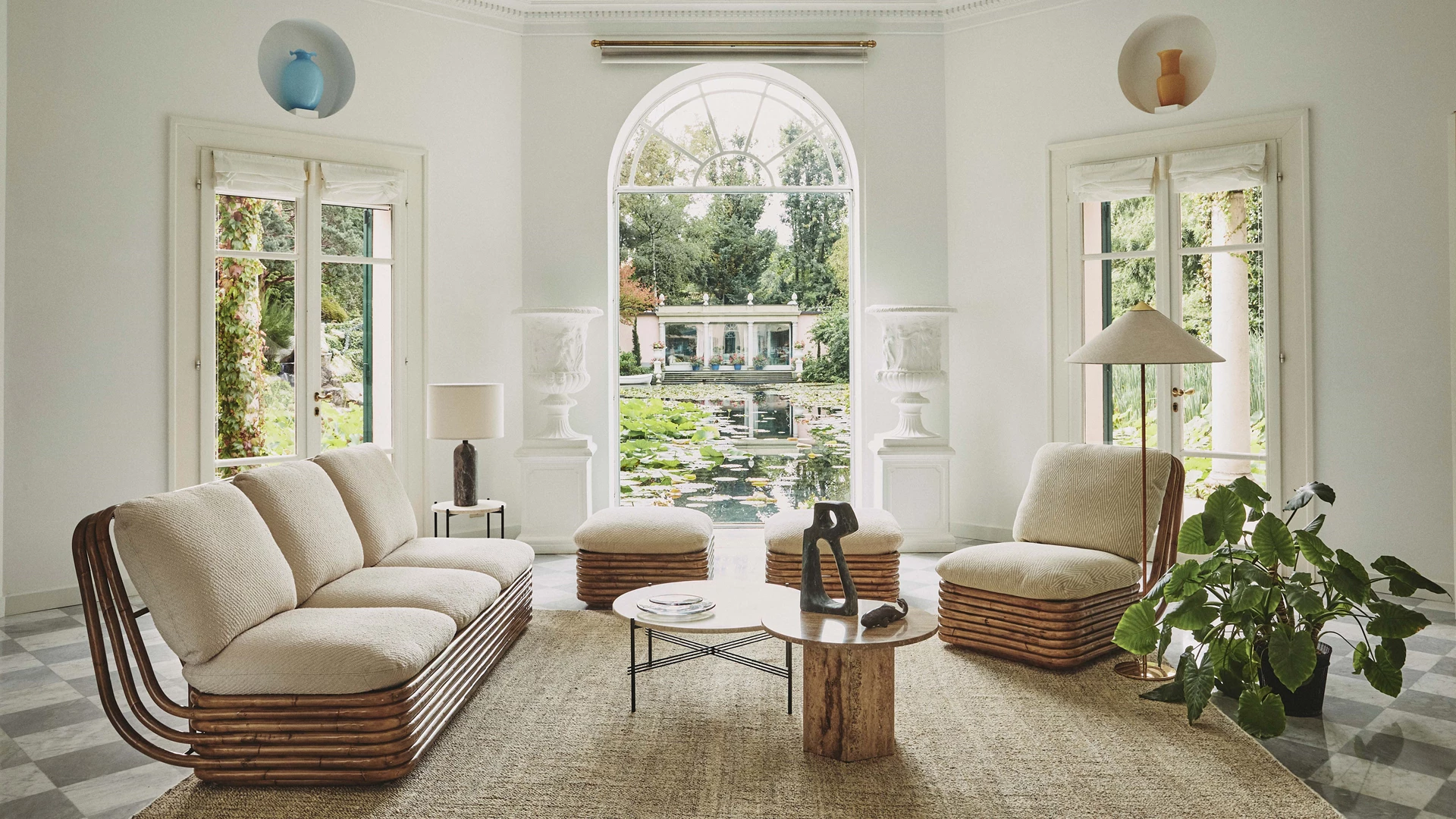
Crespi's refined lounge lifestyle
As a designer, it was her gift for streamlined forms and lavish material finishes that won her a dedicated following and saw her become a coveted partner to prestigious fashion houses ranging from Dior to Stella McCartney. When she died aged 95 in 2017, she left behind a repertoire of more than two thousand pieces, spanning furniture, jewelry, and sculpture - all imbued with an eclectic style that embraced both the organically whimsical and the formally geometric.
Distinctive and highly luxurious take on lounge furniture
Crespi designed the Bohemian 72 Collection in the spring of 1972 from the terrace of her home in Milan. Alongside the renowned ‘Rising Sun’ and ‘Five Positions’ Collections, Bohemian 72 was part of Crespi’s wider ‘Bamboo Collection’, designed between 1972 and 1975. Comprising a lounge chair, three-seater sofa, ottoman and floor lamp, the collection is the culmination of Crespi’s career-long mission to create furniture that seamlessly unites indoor and outdoor living. Drawn to rattan for its strength and versatility, she conceived these pieces at a time when the material was very much in vogue within the high-society circles in which she moved, viewed as the height of interior sophistication.
Crespi’s love of rattan
Her great ambition, she once said, was to create ‘a house of the sun’ - an environment that radiated warmth, light and sophistication. Rattan, with its gentle tones, natural appearance and the way light passes between its canes, is the perfectly material to create such a setting. To recreate Crespi’s original designs demands a high level of craftsmanship, as the rattan canes must be steamed and then bent by hand around a die, specially made to the dimensions of her drawings.