
Paavo Tynell
Paavo Tynell (1890-1973) was born in Helsinki 12 years after the invention of the domestic lightbulb - a time when Finland, like most of northern Europe, was yet to be electrified. Tynell came into the world at precisely the right time to become one of the pioneers of modern lighting; as the electric light spread across the world, so too did Tynell’s design visions. By the time he died in 1973, Tynell was known, fondly, as ‘the man who illuminated Finland’.
THE GENIUS OF PAAVO TYNELL
At the beginning, the odds of Tynell becoming one of the major design talents of the modern era would have seemed slim. He was born the seventh of nine children in a working-class family, who could not afford an education for their son beyond elementary school. At the age of 16, he went straight into an apprenticeship at G.M. Sohlberg’s metalsmith workshop, spending six years as a sheet-metal worker before taking another year-long apprenticeship as a blacksmith. Tynell’s final project of the year was a light fixture in brass - a material that he would become renowned for working with as his career blossomed.
LIGHTBULB MOMENTS
Tynell served as managing director and principal designer for for the company Taito throughout the 1920s, supported by a roster of other designers, artists, and sculptors, including Alvar Aalto, Henry Ericsson, and Ville Vallgren. By the 1930s, Taito was exclusively a lighting company, having leaned into the growing electrification of a newly independent Finland. During the interwar years, the company earned the reputation as the trendsetter in the Finnish lighting industry. Tynell’s own international reputation grew in parallel, largely thanks to high-profile lighting projects such as Parliament House in Helsinki, designed by architect Johan Sigfrid Sirén, and collaborations with leading modernist architects, notably Alvar Aalto. Taito, and Tynell in particular, became known among architects and across the country as the premier designer of light for public spaces. His talent for creating indirect light was especially sought after in spaces such as restaurants and movie theaters, where softer, more atmospheric lighting is highly prized.
EXPERIMENTATION AND EVOLUTION
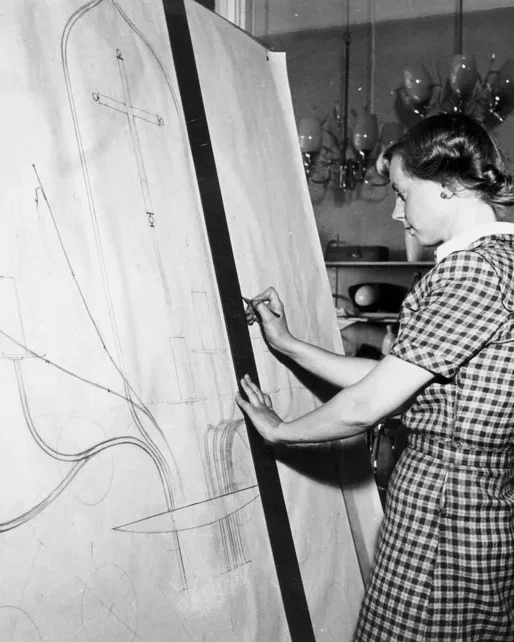
The ’30s and ’40s were largely a time of experimentation for Tynell, who evolved his style from the functionalist and art deco designs of his earlier career to more decorative and elegant expressions. Throughout this period, he served as chairman of Ornamo, Finland’s association of industrial designers, and, through Taito, he provided training and support for young designers, enlisting them as drafting assistants and training them in the skills needed to kickstart their own careers. One such assistant, the glass designer Helena Turpeinen, married Tynell in 1947.
MASTERING METAL
From the ’30s and throughout the ’50s, Tynell was considered Finland’s premier lighting designer, called on to illuminate public spaces across the country. In Helsinki in particular, Tynell’s lighting is part of the fabric of the city. Many of his grand installations survive today, in buildings ranging from train stations and churches to hotels and educational institutions.
COMING TO AMERICA
In 1948, Paavo Tynell arrived in New York, tasked with overseeing the installation of Taito Oy's latest lighting models at Finland House. Despite language barriers and financial challenges, Tynell's innovative lighting designs stole the show, garnering significant attention in the New York Times. Recognizing his importance to their venture, the Finnish-American Trading Corporation embraced Tynell, propelling him to near-celebrity status in the U.S. One of Tynell's most significant commissions during this period came from the United Nations. He was invited to design lighting for the office of the UN's first Secretary General, Trygve Lie, in the soon-to-be-finished UN Building in New York. Tynell's impact extended far beyond the UN project. His exceptional work garnered numerous new customers in the U.S. and solidified his status as a sought-after designer. His innovative designs and attention to detail captured the imagination of the design world, leaving an indelible mark on the international design landscape.